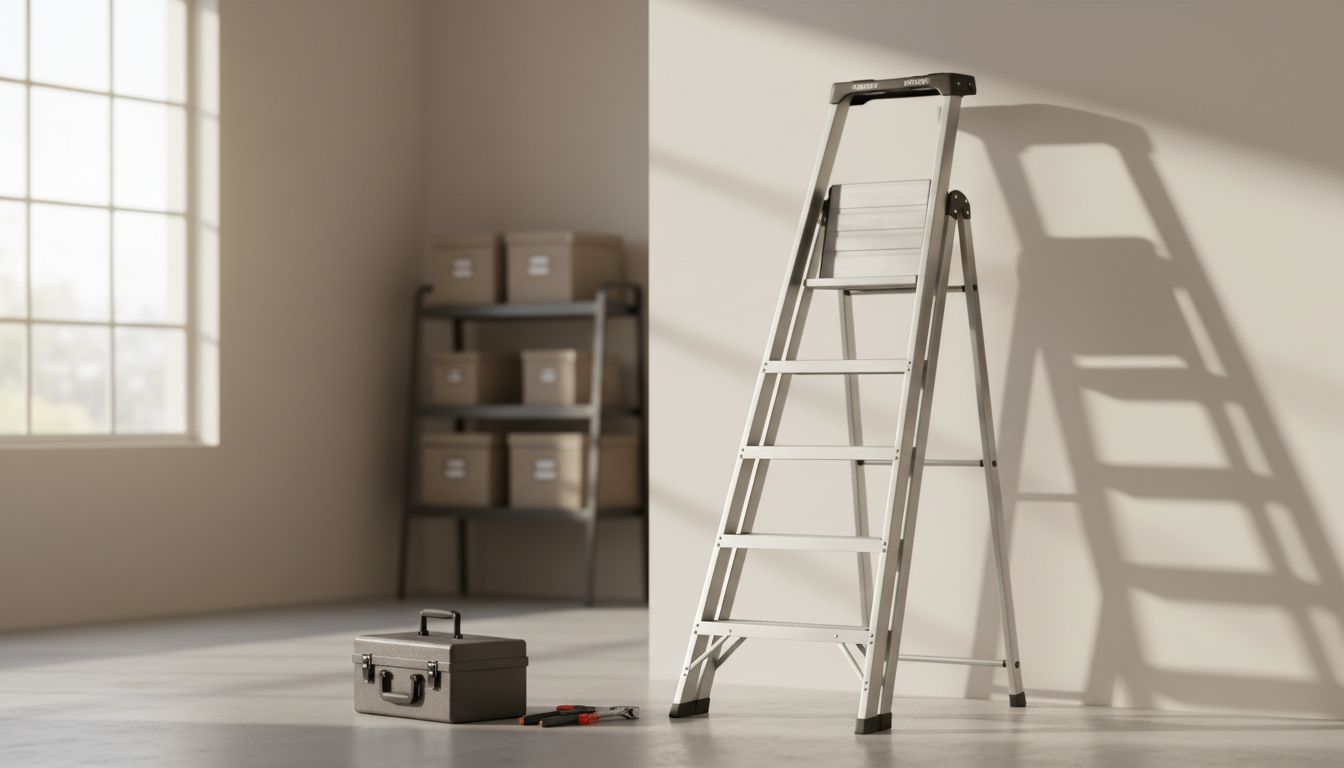
Best Ladder For Home Use In 2026 Buyer’s Guide
Table of Contents
The first time I bought a ladder, I picked the lightest one on the shelf. It fit in my trunk, so I felt clever. Then I used it to paint a stairwell, and it wobbled like a shopping cart with one bad wheel. Lesson learned.
If you’re shopping for the best ladder in 2026, don’t start with brand names. Start with reach, then stability, then storage. Once those three are right, the “best” ladder becomes obvious for your space and the jobs you actually do.
Below is the approach I use now, plus a set of solid ladder categories with realistic price ranges (since deals and stock change week to week).
Get the height right first (a simple reach formula)
Most ladder regret comes from buying too short. People then stand on a top cap, overreach, or “just do it quick.” That’s when ladders turn from tool to trap.
Here’s the simple reach math I use:
Working height (where your hands need to be) = highest safe standing level + your reach
For a rough, practical estimate, I assume my reach is about 4 ft from where my feet stand to where my hands work overhead.
So the quick formula becomes:
Highest safe standing level you need ≈ Working height − 4 ft
Example: If I need to paint a spot about 10 ft high, I want a ladder where my safe standing level is around 6 ft. On a step ladder, that usually means an 8 ft step ladder (because you don’t stand on the top steps).
A few reach rules that keep me out of trouble:
- On a step ladder, don’t stand on the top cap. Many models also warn against the top one or two steps.
- On an extension ladder, the top should extend about 3 ft above the landing if you’re stepping onto a roof or platform.
- Check the duty rating, not just the height. Your weight plus tools matters. Common ratings are Type I (250 lb), Type IA (300 lb), and Type IAA (375 lb).
If you want a deeper, practical rundown of ladder types and how to choose, I like this recent overview from Popular Mechanics’ DIY ladder guide. It matches how most homeowners actually use ladders.
Recommended ladders by category (what I’d buy for each job)
 Photo by Anete Lusina
I’m not going to pretend there’s one ladder that wins every home. The best ladder depends on whether you’re cleaning gutters, swapping light fixtures, or squeezing it into a closet.
Here’s a quick comparison of what tends to work well in real homes (with examples that show up repeatedly in 2025 to 2026 reviews and store shelves). Use these as a shortlist, then compare specs.
| Category | Best fit for | What I look for | Example models you’ll see often | Typical price range (2026) |
|---|---|---|---|---|
| Best overall | One ladder for mixed jobs | Multi-position, Type IA, solid locks, optional levelers | Little Giant Velocity, Gorilla Multi-Position | $200 to $500 |
| Best step ladder | Indoors, painting, fixtures | Wide steps, stable feet, light carry | DeWalt 4 ft fiberglass step ladder, Cosco Signature Series | $80 to $150 |
| Best extension ladder | Gutters, roof edge, tall siding | Smooth extend, secure rung locks, stabilizer option | Werner D6228-2, Werner GlideSafe series | $200 to $400 |
| Best multi-position | Stairs, uneven ground, “odd” reaches | Fast hinge locks, rigid feel, clear lock indicators | Little Giant Velocity or Epic series | $250 to $500 |
| Best budget | Occasional light chores | Decent stance width, non-slip steps, honest rating | Basic aluminum step ladder from a major retailer | $50 to $100 |
| Best for small spaces | Apartments, RV, tight storage | Compact fold, pinch protection, stable base | Xtend & Climb 770P, other telescoping ladders | $100 to $250 |
Two quick notes from my own experience:
First, for roof and gutter work, I’m picky. I’d rather buy an extension ladder that feels boring and sturdy than something “clever” that flexes. This roundup from This Old House’s extension ladder review is useful because it focuses on homeowner tasks and what features matter.
Second, for small spaces, telescoping ladders are tempting. Just be choosy. A cheap telescoping ladder can feel fine until the locks get gritty. If storage is your main issue, skim This Old House’s telescoping ladder picks and pay attention to lock design and pinch points.
My personal rule: if a ladder’s locks feel fussy in the store, they’ll feel worse when you’re tired and halfway done.
Fiberglass vs aluminum ladders (the real tradeoff)
I’ve owned both. I still use both. The “best” material depends on where and how you work.
Aluminum ladder pros and cons
Aluminum is my choice when I’ll move the ladder a lot.
- Pros: lighter to carry, often cheaper, doesn’t rust
- Cons: conducts electricity, can dent or bend, can feel springy on taller ladders
Fiberglass ladder pros and cons
Fiberglass is my choice when I want a stiffer feel or I’m anywhere near electrical work.
- Pros: non-conductive (safer near electricity), tougher against weather, often feels more rigid
- Cons: heavier, usually costs more, can get itchy if the surface wears (gloves help)
If there’s any chance you’ll be near a service drop, exterior lights, or overhead lines, I lean fiberglass. Even then, I treat every wire like it’s live and too close.
Ladder safety checklist I actually follow
I’m not perfect, so I use a short checklist that catches the big mistakes before I climb.
Setup angle (extension ladders)
I use the 4-to-1 rule: for every 4 ft of height, set the base 1 ft out. It’s simple, and it works. OSHA repeats this guidance in their materials, along with other extension ladder basics like extending above landings and securing the top when possible. See OSHA’s extension ladder safety fact sheet (PDF).
3-point contact
I keep two hands and one foot, or two feet and one hand, on the ladder at all times. If I can’t, I stop and change the plan. That usually means a tool belt, a hoist line, or moving the ladder closer.
Quick inspection before every use
This takes about 20 seconds and has saved me more than once:
- Feet: rubber pads intact, not worn slick
- Rails and rungs: no cracks, bends, or loose rivets
- Locks and hinges: click fully into place, no “almost locked” positions
- Labels: readable duty rating and warnings (if the label’s gone, I get cautious)
For standards and what “rated” really means, I also like the plain-language overview on ANSI portable metal ladder safety requirements. It’s not light reading, but it’s trustworthy context.
Conclusion: the best ladder is the one you’ll use safely
When I buy the best ladder for my home, I’m really buying confidence. I want the right height, a real duty rating, and a setup that doesn’t tempt bad habits. From there, I pick the style that fits my storage and my most common jobs.
If you’re stuck between two options, I’d choose the one that feels more stable underfoot, even if it costs a bit more. Stability is what keeps a “quick task” from turning into a story you don’t want to tell later.